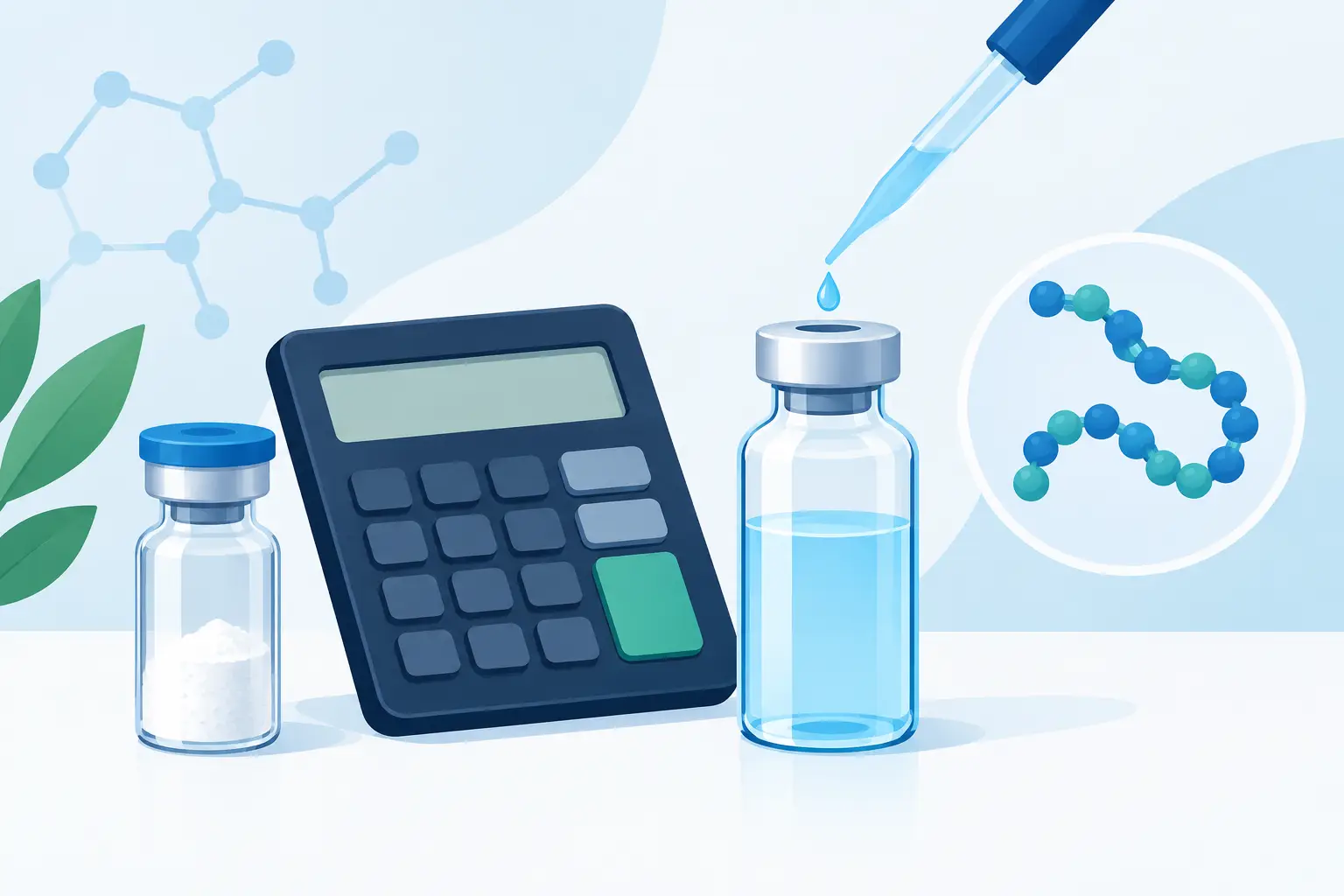
A lyophilized peptide vial can contain the correct mass and still produce an unusable research preparation if the reconstitution volume is wrong. A peptide reconstitution volume calculator turns vial mass, target concentration, and withdrawal volume into a documented set of values that can be checked before material is handled. For research-use-only materials, that repeatability matters as much as the arithmetic itself.
The calculation is straightforward. The discipline comes from keeping units aligned, selecting a concentration that fits the research workflow, and recording what was actually added to the vial. A calculator should support that process, not replace verified laboratory procedures, lot documentation, or material-specific handling requirements.
What a Peptide Reconstitution Volume Calculator Solves
A reconstitution calculator answers three related questions:
- How much diluent is required to reach a selected concentration?
- What concentration results from a known vial mass and added volume?
- What volume contains a required mass of material for a research preparation?
These are different versions of the same relationship:
Concentration = peptide mass / reconstitution volume
When the desired concentration is known, rearrange the equation:
Reconstitution volume = peptide mass / target concentration
When the concentration is known and a defined mass is needed for a research sample:
Withdrawal volume = required peptide mass / concentration
The calculator is only as reliable as its inputs. Confirm the labeled peptide content in the vial, use the intended units, and enter the actual volume added rather than the planned volume if those values differ.
Start With Consistent Units
Most preventable errors occur before any calculation begins. Peptide vial content is often expressed in milligrams, while working quantities may be recorded in micrograms and liquid volumes in milliliters or microliters.
The core conversions are:
- 1 milligram (mg) = 1,000 micrograms (mcg)
- 1 milliliter (mL) = 1,000 microliters (mcL)
- 1 mg/mL = 1 mcg/mcL
That last relationship is particularly useful. A concentration of 2.5 mg/mL is also 2.5 mcg/mcL. It allows a researcher to calculate a small liquid volume without repeatedly converting both sides of the equation.
Use one unit system throughout a single calculation. For example, either work in mg and mL or in mcg and mcL. Mixing 5 mg with 250 mcg/mL without conversion creates a 1,000-fold error. A calculator may appear to return a precise result, but precision cannot correct incompatible inputs.
Example: Calculating Reconstitution Volume
Consider a vial labeled with 5 mg of peptide. A laboratory protocol calls for a working concentration of 2.5 mg/mL.
The required reconstitution volume is:
5 mg / 2.5 mg/mL = 2 mL
Adding 2 mL of the specified compatible diluent produces a nominal concentration of 2.5 mg/mL, or 2.5 mcg/mcL. If a later research preparation requires 250 mcg of material, the calculated withdrawal volume is:
250 mcg / 2.5 mcg/mcL = 100 mcL
The math is simple, but the record should still include the vial lot, labeled mass, diluent identity, volume added, date, target concentration, and storage condition. That documentation makes the preparation traceable when work is repeated or reviewed.
Choose a Target Concentration for the Workflow
There is no universal reconstitution volume for a given peptide vial. The right volume depends on the required concentration, the accuracy range of available measurement tools, sample volume constraints, and the stability guidance applicable to the material.
A more concentrated preparation uses less diluent and reduces the volume needed for a given mass. That can be useful where sample volume is limited. However, very small withdrawals may fall outside the most reliable range of the available pipette or syringe, increasing relative measurement error.
A less concentrated preparation makes small masses easier to measure as larger liquid volumes. The trade-off is a larger final volume, which may not suit every assay or storage configuration. The practical goal is not to create the most concentrated solution possible. It is to select a concentration that supports accurate, repeatable liquid handling within the established research method.
Account for Measurement Reality, Not Just Formula Results
A peptide reconstitution volume calculator produces a nominal concentration. Real-world preparation introduces tolerances that should be acknowledged in research documentation.
First, volume delivery has limits. A 1 mL transfer measured with appropriately selected calibrated equipment is not equivalent to estimating a small fraction of a milliliter using an unsuitable device. Select equipment whose operating range comfortably includes the intended volume.
Second, vial content and liquid behavior matter. The labeled mass is the basis for the nominal calculation, while retained liquid on a vial surface, incomplete transfer, foam, or an inaccurate delivered volume can affect the final preparation. Follow the material’s handling instructions and the laboratory’s validated procedures rather than forcing a calculation to fit an inconvenient volume.
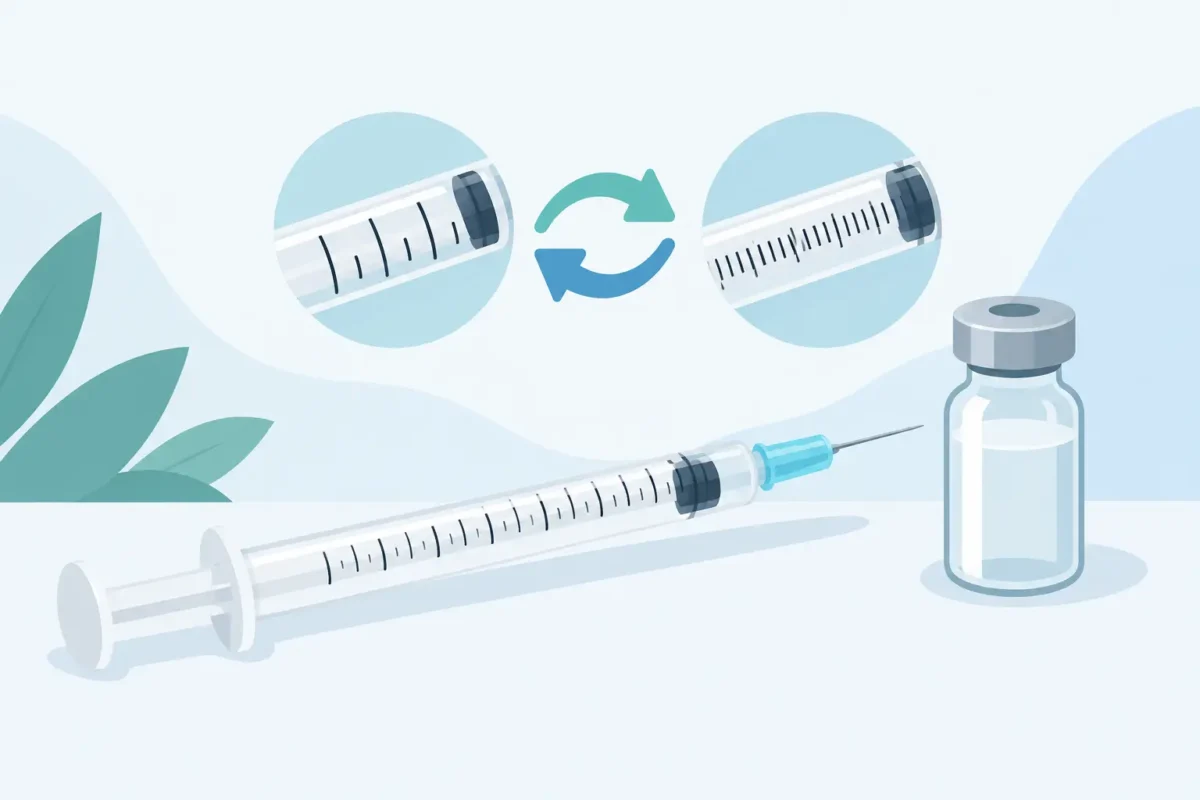
Third, do not confuse container markings with concentration. If a laboratory uses U-100 syringe markings as a volumetric reference, 100 units corresponds to 1 mL and 1 unit corresponds to 0.01 mL. Those markings describe liquid volume, not peptide mass. The mass associated with any marking changes with the calculated concentration.
A Practical Verification Sequence
Before finalizing a preparation, use a short verification sequence. It catches the errors that are easy to miss when calculations are performed quickly.
- Confirm the vial’s labeled peptide mass and lot-specific documentation.
- State the target concentration with both mass and volume units, such as mg/mL.
- Calculate the diluent volume, then calculate a separate check using the resulting concentration.
- Record the actual volume added and recalculate if it differs from the intended amount.
- Verify that the planned withdrawal volume is within the reliable range of the selected measurement device.
For the 5 mg vial reconstituted with 2 mL, the check is 5 mg divided by 2 mL, which returns 2.5 mg/mL. A second check confirms that 100 mcL at 2.5 mcg/mcL contains 250 mcg. Independent checks are valuable because they approach the same preparation from different directions.
Common Calculator Errors
The most frequent error is entering the total vial mass in milligrams while choosing a concentration expressed in micrograms per milliliter. Convert before calculating. A 10 mg vial contains 10,000 mcg, not 10 mcg.
Another common issue is treating a target quantity as a target concentration. A request for 500 mcg identifies a mass, while 500 mcg/mL identifies a concentration. One tells you how much material is needed; the other tells you how much material is present per unit volume.
Rounding too early can also create avoidable drift. Keep several decimal places during calculation, then round only to a value that can be delivered accurately with the available equipment. If the calculated volume is impractical to measure, reconsider the target concentration rather than relying on an arbitrary approximation.
Finally, do not assume all lyophilized materials share the same diluent, mixing approach, storage condition, or post-reconstitution hold time. The concentration calculation is universal, but handling requirements are compound- and lot-specific. Research materials should remain within their stated RUO designation and applicable laboratory controls.
Documentation Supports Reproducible Research
For repeat work, the calculation should be recorded as part of the preparation record, not left as a one-time result on a calculator screen. At minimum, retain the peptide name, vial label information, lot number, labeled content, diluent, volume added, final nominal concentration, preparation date, and storage details.
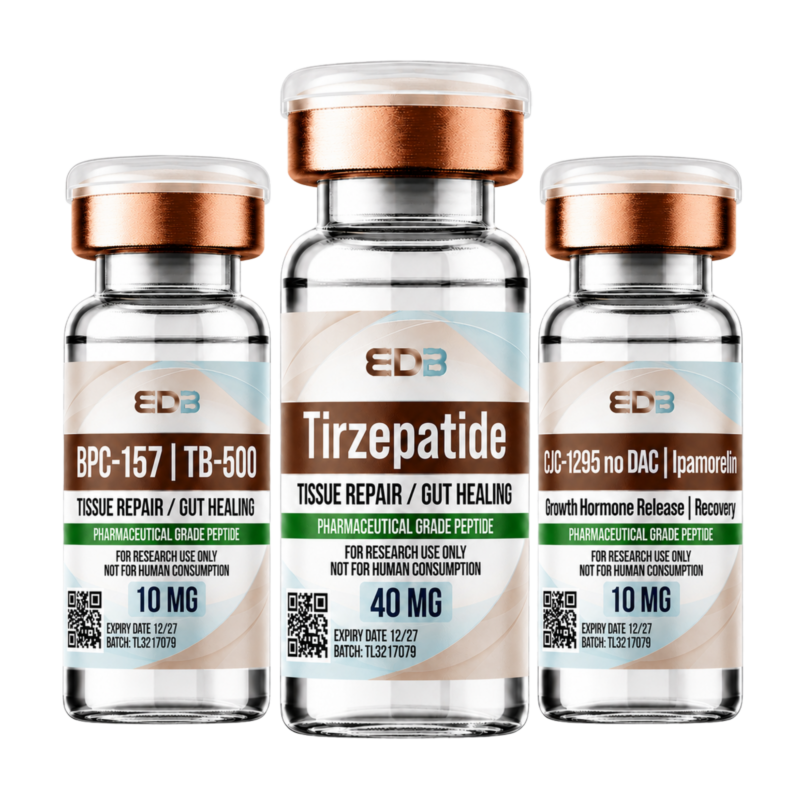
EDB Peptides emphasizes practical concentration information alongside documented quality signals because clear math and lot-level traceability serve the same purpose: they reduce uncertainty before a vial enters a research workflow. A clean calculation cannot establish identity or purity, but paired with the correct documentation, it helps preserve consistency from receipt through preparation.
A well-chosen reconstitution volume makes each later measurement easier to defend, repeat, and compare. Treat the calculator result as the start of a controlled preparation record, then let verified handling practices carry the work forward.








One thought on “Peptide Reconstitution Volume Calculator Guide”