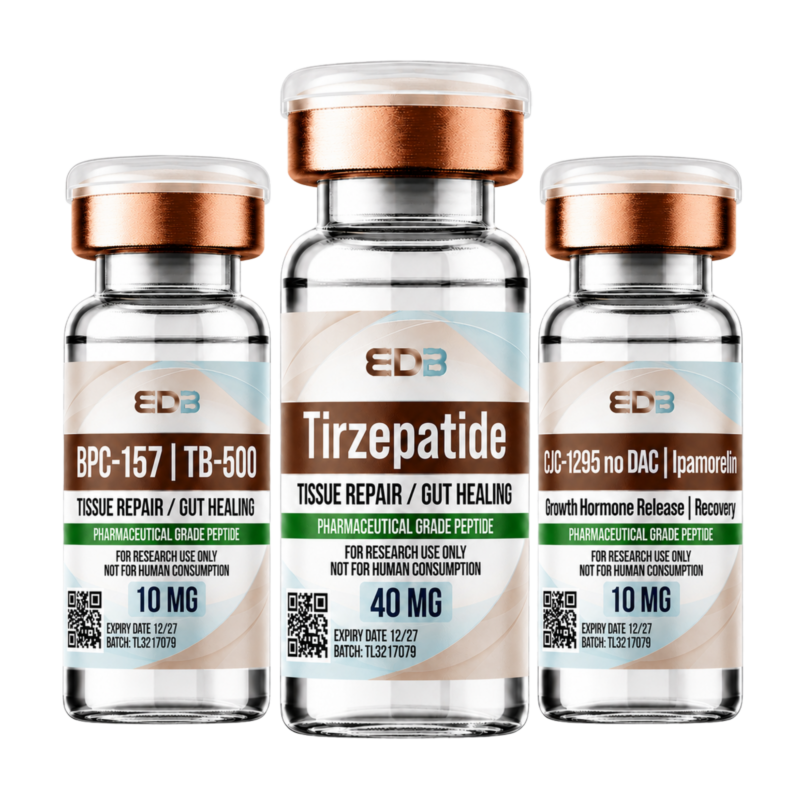
A CJC-1295 no DAC research peptide is not a category where a label alone provides enough information for disciplined laboratory purchasing. The naming is familiar, but the practical questions are more specific: What molecular form is supplied? How is identity supported? What does the lot-level documentation show? And can the material be handled consistently from receipt through reconstitution and storage?
For research purchasers working with lyophilized peptides, those details determine whether an incoming vial is a usable research material or an avoidable source of uncertainty. A documented product specification, protected packaging, and a clear chain of quality-control information matter as much as the compound name on the carton.
What distinguishes CJC-1295 no DAC?
CJC-1295 no DAC generally refers to a growth hormone-releasing hormone analog supplied without the Drug Affinity Complex, or DAC, modification. The DAC-containing version is designed around extended association with circulating albumin. The no-DAC form does not include that added complex, so it represents a distinct molecular format with different persistence characteristics in research settings.
The terminology deserves careful attention. In peptide catalogs and research discussions, CJC-1295 no DAC may also be described using terms such as modified GRF 1-29. Those names are often used in related contexts, but researchers should not treat naming conventions as a substitute for reviewing the exact listed sequence, molecular weight, vial content, and certificate of analysis for the specific lot being evaluated.
That distinction becomes especially relevant when comparing materials across vendors. Two listings may appear similar based on a short product title while differing in stated peptide content, testing documentation, excipient disclosure, or handling guidance. A reliable purchase decision starts with the actual specification, not a generalized assumption about the name.
Why documentation is part of the specification
For a CJC-1295 no DAC research peptide, quality documentation should be viewed as a working laboratory record rather than a marketing accessory. The certificate of analysis should connect to the lot received and provide the information needed to assess identity and reported purity. When available, analytical support such as chromatographic and mass-based testing adds useful context to that record.
A practical documentation review typically centers on four questions:
- Does the certificate identify the same lot number shown on the vial or outer packaging?
- Does it state the peptide identity and reported purity result clearly?
- Are the testing method, test date, and material details sufficiently specific to be meaningful?
- Is the reported vial content consistent with the product specification used for experimental planning?
Lot matching is not a minor administrative detail. It is what ties an individual vial to its quality record. Without that connection, a generic certificate offers substantially less value when questions arise about material identity, storage history, or reproducibility.
Third-party testing claims should also be read with appropriate precision. A claim is most useful when it is supported by accessible, lot-specific documentation rather than broad statements that cannot be connected to the inventory received. Research buyers should favor suppliers that make traceability visible before the material enters their workflow.
Receiving and inspecting lyophilized material
The first inspection begins when the shipment arrives. Before reconstitution, confirm the product name, vial count, lot number, and any listed storage conditions against the order and supporting documentation. Inspect the vial, stopper, seal, and outer packaging for signs of compromised transit conditions.
Lyophilized peptide material should appear consistent with the supplier’s stated presentation. However, visual appearance alone cannot verify identity or purity. A vial that looks intact still requires its corresponding documentation, while a vial with visible damage should be isolated and reported before it is introduced into laboratory work.
Professional packaging is part of product integrity, particularly for temperature-sensitive research materials. Protective secondary packaging, clear labeling, and cold-chain-conscious fulfillment practices help reduce avoidable variables during transit. They do not replace appropriate storage after delivery, but they provide a more controlled handoff between supplier and researcher.
Reconstitution requires controlled math, not assumptions
Reconstitution is where a correctly labeled vial can become an incorrectly understood solution. The calculation itself is straightforward, but errors commonly arise when researchers confuse milligrams with micrograms, misread solvent volume, or apply a reference table intended for a different vial size.
The core concentration calculation is:
Concentration (mcg/mL) = total peptide amount (mcg) / total reconstitution volume (mL)
For example, a vial containing 5 mg of material represents 5,000 mcg. If it is reconstituted with 2 mL of an appropriate laboratory solvent, the resulting nominal concentration is 2,500 mcg/mL. That calculation describes solution concentration only. It does not establish a protocol, a research endpoint, or suitability for any particular application.
Use the vial’s stated content rather than an assumed amount, record the solvent volume precisely, and retain the resulting concentration calculation with the experimental record. If a product page or supplier guide provides concentration tables, confirm that the table matches the exact vial strength and volume selected. A correct table applied to the wrong vial still produces the wrong answer.
Good handling practice also includes using suitable aseptic technique, avoiding unnecessary agitation, and limiting repeated temperature cycling. The appropriate reconstitution solvent, storage duration, and post-reconstitution conditions should follow the supplier’s product-specific instructions and the requirements of the laboratory protocol.
Storage controls protect the research timeline
Storage guidance should be treated as a condition of the material specification. Lyophilized peptides and reconstituted solutions may have different stability considerations, and a blanket storage rule is rarely sufficient for every product or research design.
Before opening the vial, establish how it will be labeled, where it will be stored, and who will record handling events. At a minimum, laboratory records should capture the lot number, date received, storage condition, date of reconstitution, solvent and volume used, calculated concentration, and any aliquoting performed. This level of control is useful even for small research operations because it creates a practical audit trail when results need to be reviewed later.
Aliquoting may reduce repeated access to a primary reconstituted vial when the research plan requires multiple time points. Whether that approach is appropriate depends on the compound, solution stability, container compatibility, and laboratory procedure. The objective is not to create more steps. It is to reduce uncontrolled variables that can affect material handling over time.
Comparing suppliers beyond the listed price
The lowest listed price is not always the lowest research cost. An undocumented vial that introduces uncertainty around identity, purity, or concentration may consume more time and material than it saves. For repeat purchasers, consistency in packaging, records, and fulfillment is often more valuable than a marginal difference in unit price.
A well-qualified supplier should make the basics easy to verify: standardized vial format, lot-level COA availability, clear research-use-only designation, practical storage information, and responsive order support. Secure checkout and dependable delivery also matter because they reduce friction in an otherwise detail-sensitive purchasing process.
EDB Peptides approaches peptide supply with that operational standard in mind, emphasizing documented inventory, professional packaging, and practical handling information for research purchasers. The goal is not to overstate what a peptide can do. It is to provide research materials with the traceability and clarity needed for informed laboratory handling.
Research-use-only boundaries remain essential
CJC-1295 no DAC is supplied for laboratory research purposes only. It is not approved as a drug, dietary supplement, or product for human or veterinary use. Product descriptions, concentration examples, and storage guidance should never be interpreted as medical advice or as instructions for administration.
That boundary supports better research discipline. A responsible supplier provides transparent material information, while the researcher remains responsible for protocol design, institutional requirements, safety procedures, and appropriate use within a legitimate research setting.
The most useful CJC-1295 no DAC research peptide purchase is one that arrives with fewer unanswered questions: a clearly identified vial, a matching lot record, credible analytical documentation, and handling instructions that can be incorporated into a controlled workflow. When those fundamentals are in place, researchers can spend less time resolving supply uncertainty and more time maintaining the consistency their work requires.