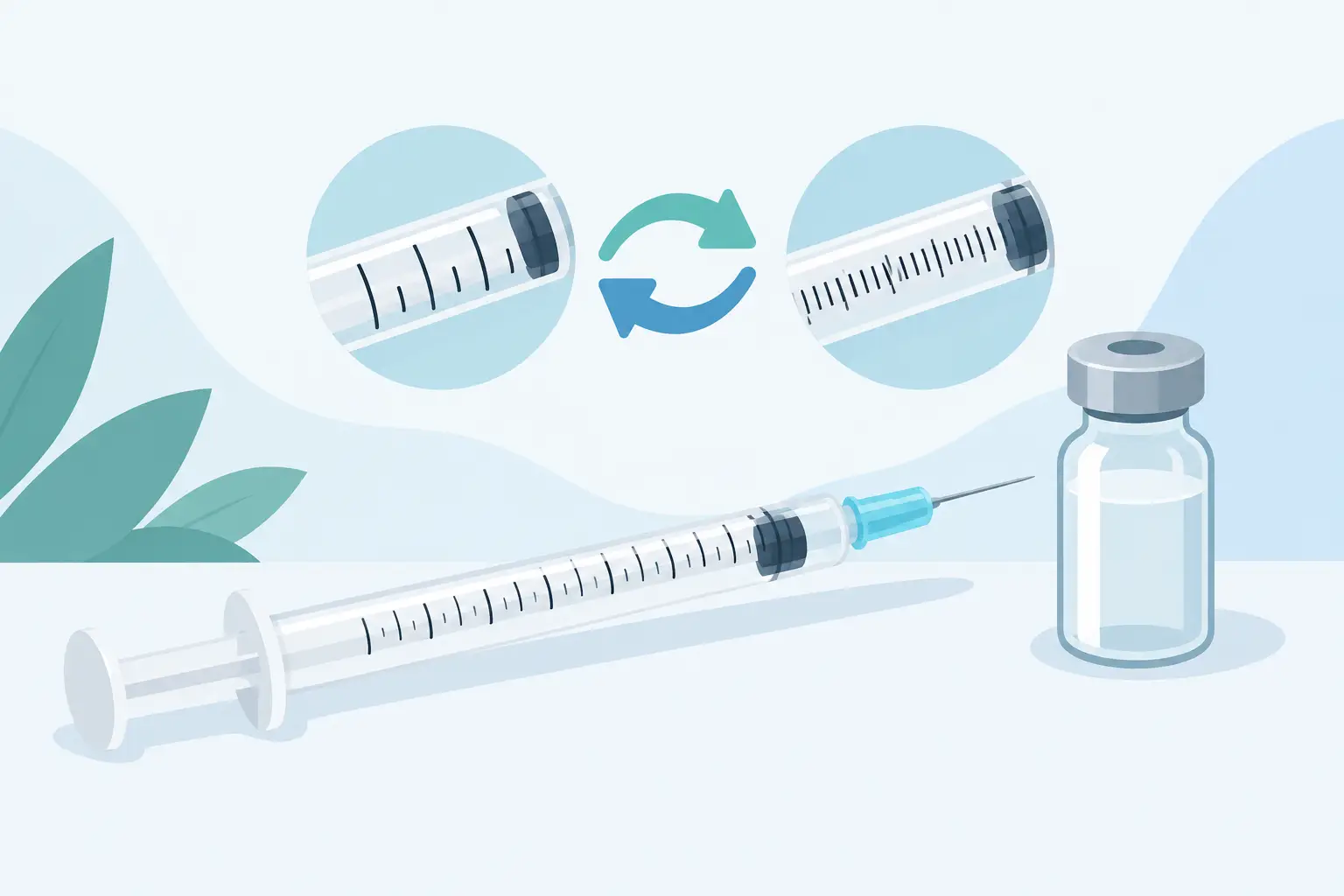
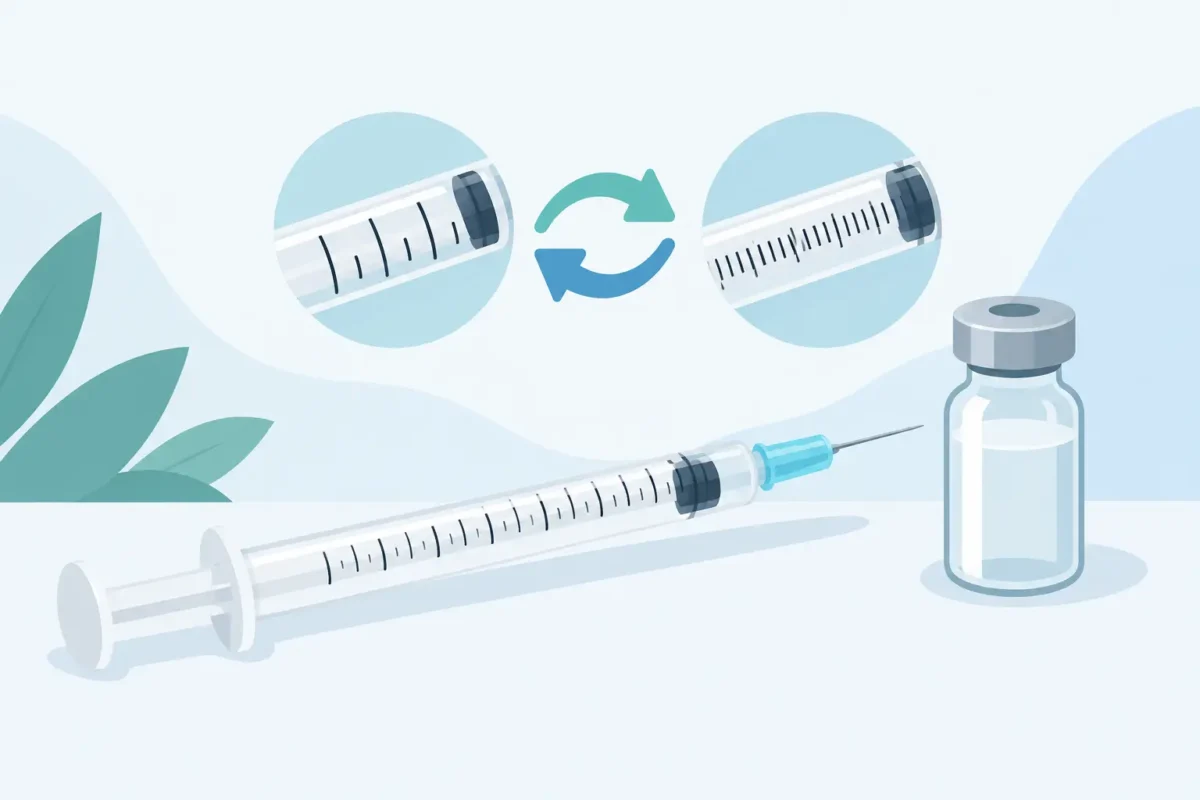
A U-100 insulin syringe does not measure peptide mass. It measures liquid volume. That distinction is the entire foundation of accurate u-100 syringe peptide unit conversion. The syringe marking tells a researcher how much reconstituted solution is being drawn, while the vial concentration determines how much peptide is contained in that volume.
For research materials, a clean calculation begins with documented vial content, a known reconstitution volume, and a correctly identified syringe. When any one of those inputs is assumed rather than verified, the resulting unit conversion can be wrong even when the arithmetic appears correct.
What U-100 Means on a Syringe
A U-100 syringe is calibrated so that 100 syringe units equal 1 milliliter (mL) of liquid. Therefore, each unit equals 0.01 mL.
The core volume reference is straightforward:
- 100 units = 1.00 mL
- 50 units = 0.50 mL
- 25 units = 0.25 mL
- 10 units = 0.10 mL
- 1 unit = 0.01 mL
Those markings are volume measurements only. They do not inherently correspond to micrograms (mcg), milligrams (mg), or a particular research compound. A 10-unit draw from one vial can contain a very different peptide quantity than a 10-unit draw from another vial because the final concentration may differ.
This is why a syringe should never be used as a shortcut for mass-based calculations. First establish concentration in mcg/mL or mg/mL. Then translate the required liquid volume to U-100 units.
The U-100 Syringe Peptide Unit Conversion Formula
Use the following sequence for consistent conversion:
1. Find the vial concentration
Peptide concentration = total peptide mass ÷ total reconstitution volume
For example, a vial containing 5 mg of material reconstituted with 2 mL of bacteriostatic water has a concentration of:
5 mg ÷ 2 mL = 2.5 mg/mL
The same concentration expressed in micrograms is 2,500 mcg/mL, since 1 mg equals 1,000 mcg.
2. Calculate the required volume
Required volume in mL = target peptide mass ÷ concentration
3. Convert mL to U-100 syringe units
Syringe units = volume in mL × 100
Combined into one practical formula:
U-100 units = target mass ÷ concentration in mcg/mL × 100
This formula applies only after the vial concentration has been confirmed. It is a calculation tool for laboratory handling, not a substitute for a validated research protocol, institutional procedures, or compound-specific documentation.
Worked Example: 5 mg Vial Reconstituted With 2 mL
Consider a 5 mg lyophilized peptide vial reconstituted with 2 mL of diluent.
The concentration is 5 mg ÷ 2 mL = 2.5 mg/mL. In micrograms, that is 2,500 mcg/mL.
At this concentration, every 0.01 mL U-100 syringe unit contains:
2,500 mcg/mL ÷ 100 units/mL = 25 mcg per unit.
The resulting reference points are simple:
- 4 units = 100 mcg
- 10 units = 250 mcg
- 20 units = 500 mcg
- 40 units = 1,000 mcg, or 1 mg
The value per unit is not universal. If the same 5 mg vial were reconstituted with 1 mL instead, the concentration would double to 5,000 mcg/mL. Each U-100 unit would then equal 50 mcg, not 25 mcg.
Why Reconstitution Volume Changes Everything
The amount printed on a vial identifies total material in the vial. It does not establish the amount contained in a syringe unit until a reconstitution volume is selected.
A 10 mg vial reconstituted with 1 mL produces 10 mg/mL. That same 10 mg vial reconstituted with 2 mL produces 5 mg/mL. Both preparations contain the same total peptide, but the U-100 unit conversion differs by a factor of two.
This is the most common source of avoidable confusion: using a conversion chart created for one reconstitution volume with a vial prepared at another volume. A chart may be mathematically correct and still be incorrect for the actual vial in front of the researcher.
Record the reconstitution volume directly on the vial label or accompanying laboratory record. Include the date, compound or blend name, total vial content, diluent volume, calculated concentration, and calculated mass per U-100 unit. This small documentation step creates a useful verification point for every subsequent draw.
Blends Require Total-Concentration Clarity
Peptide blends require additional attention because a label may list multiple components. A blend described as 5 mg/5 mg contains 10 mg of total material, but it contains 5 mg of each individual component.
If that vial is reconstituted with 2 mL, the total blend concentration is 5 mg/mL. Each component concentration is 2.5 mg/mL. On a U-100 syringe, one unit represents 0.01 mL, which contains 50 mcg of total blend and 25 mcg of each listed 5 mg component.
The correct calculation depends on what the research protocol identifies: total blend mass or the mass of a specific component. Treating the total mass as though it belongs to one ingredient will overstate that ingredient’s concentration.
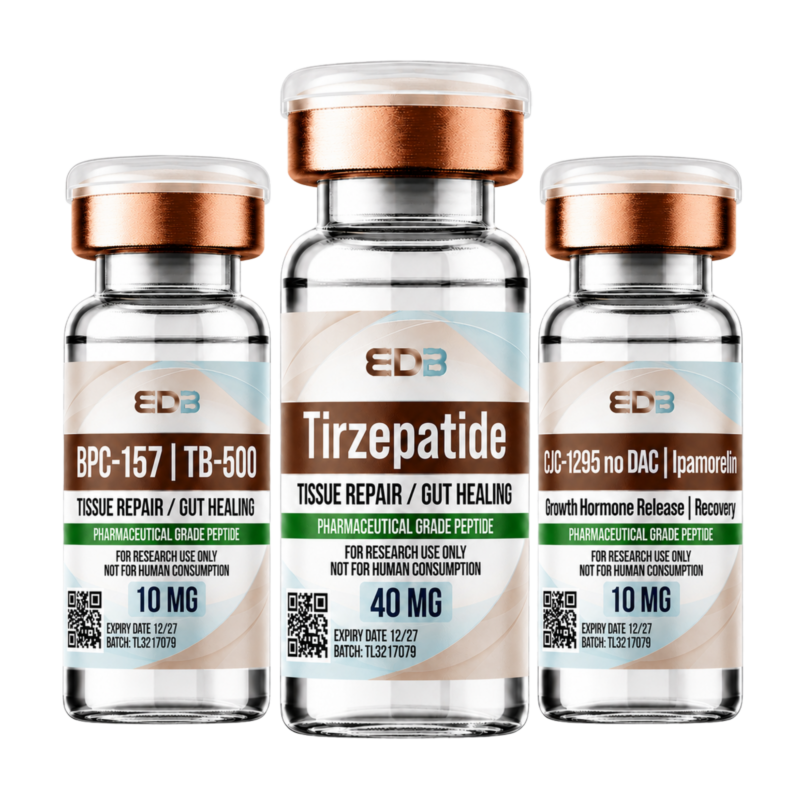
For multi-peptide formats, confirm whether listed amounts are per vial, per component, or total combined content before calculating units. Lot-level documentation and the product specification should be the controlling references.
Practical Checks Before Drawing a Sample
A reliable calculation should survive a quick second review. Start by confirming the syringe type. U-100 markings are different from U-40 markings, tuberculin syringes, and non-calibrated transfer devices. Do not transfer a U-100 conversion directly to another syringe style.
Next, keep units consistent. A calculation that begins in milligrams and ends in micrograms without a 1,000-fold conversion is likely to produce an error. It is often easiest to convert the full vial amount to micrograms at the beginning, calculate mcg/mL, and then determine mcg per syringe unit.
Finally, use the physical syringe carefully. Some syringes have fine 1-unit markings, while others use wider graduations. Read the leading edge of the stopper nearest the needle, remove obvious air bubbles, and avoid estimating fractional markings beyond what the syringe can reasonably support. If a required volume is below the syringe’s practical readability, a different reconstitution volume or a more appropriate measuring device may provide better control.
A Reusable Calculation Record
For repeatable laboratory work, record five values together: vial content, reconstitution volume, concentration in mcg/mL, mcg per U-100 unit, and the corresponding volume for the intended research aliquot. This turns an isolated calculation into a traceable handling record.
For example, a note reading “5 mg in 2 mL = 2,500 mcg/mL = 25 mcg per U-100 unit” makes the relationship immediately auditable. It also makes it easier for another qualified researcher to verify the preparation without reconstructing the math from memory.
EDB Peptides supports this level of handling discipline by pairing research-use-only materials with clear specifications, storage information, and lot-level quality documentation. Those details matter because dependable calculations begin with dependable starting information.
A U-100 syringe is a precise volume tool when its markings are connected to a verified concentration. Keep the vial math, reconstitution record, and syringe calibration together, and each unit marking remains clear, reproducible, and fit for careful research handling.