
Quick answer: In the thymosin beta-4 vs TB-500 comparison, thymosin beta-4 (Tβ4) is a naturally occurring 43-amino-acid protein found in nearly all human cells, while TB-500 is a synthetic peptide marketed as a shorter version of it, usually based on the region of Tβ4 that binds actin. They are related, but they are not the same molecule, and results from one cannot be assumed to apply to the other.
What Is Thymosin Beta-4?
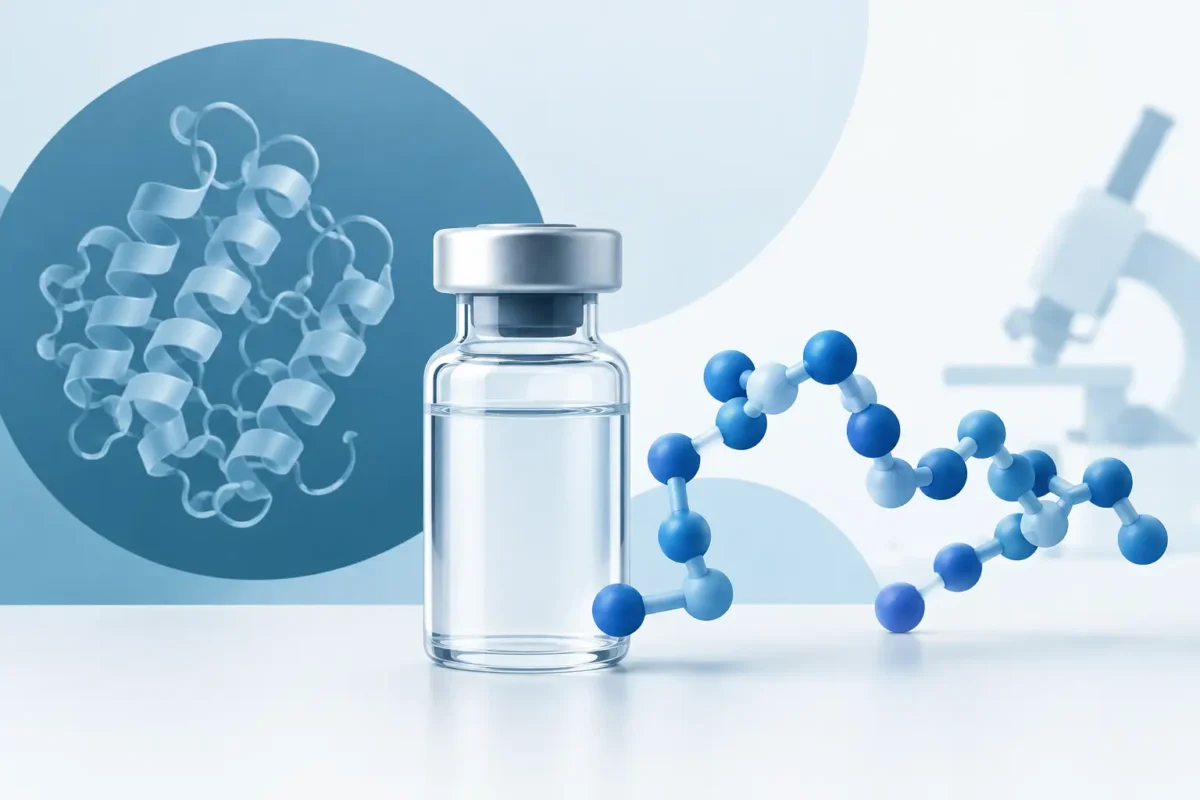
Thymosin beta-4 is an endogenous peptide of 43 amino acids, with a molecular weight of roughly 4.9 kDa. It was first isolated from calf thymus tissue and is now known to be expressed throughout the body, especially in platelets, white blood cells and wound-site tissue.
Its best-documented role is as the main G-actin-sequestering protein in mammalian cells. By binding monomeric actin, it helps regulate the cytoskeleton, which affects how cells move, divide and change shape. Published preclinical work has also examined Tβ4 in relation to cell migration, angiogenesis, inflammation signaling and tissue repair models.
What Is TB-500?
TB-500 is the name commonly used by research suppliers for a synthetic peptide derived from Tβ4. Most descriptions point to a fragment containing the actin-binding motif, often cited as the sequence LKKTETQ (residues 17 to 23 of Tβ4), sometimes with an acetylated N-terminus.
There is no single universal definition. Some suppliers use “TB-500” for a short fragment, while others use it loosely for full-length Tβ4. This is why confirming the exact sequence on a certificate of analysis matters before comparing any data.
thymosin beta-4 vs tb-500: Side-by-Side
| Feature | Thymosin beta-4 (Tβ4) | TB-500 |
|---|---|---|
| Origin | Naturally occurring in humans and other animals | Synthetic, made by solid-phase peptide synthesis |
| Length | 43 amino acids | Usually a short fragment (commonly cited as 7 residues, varies by supplier) |
| Molecular weight | About 4.9 kDa | Much smaller, depending on the fragment |
| Core activity studied | Actin sequestration, cell migration, tissue repair models | Actin-binding region, studied as the active domain |
| Research evidence | Extensive preclinical literature, some early clinical trials of a recombinant form | Far less peer-reviewed data under the TB-500 name |
| Naming consistency | Clear and standardized | Inconsistent between suppliers |
| Regulatory status | Not approved as a drug for general use | Not approved for human use; prohibited in sport by WADA |
Key Differences Explained
1. Structure and size
The most basic difference is length. Full-length Tβ4 has 43 residues and folds in ways that matter for how it interacts with actin and other binding partners. A fragment such as LKKTETQ keeps only one functional region, so it cannot be assumed to reproduce every activity of the whole protein.
2. Strength of the evidence
Tβ4 has been studied for years in cell culture, animal models of cardiac, corneal and dermal injury, and in a limited number of early-stage human trials using a recombinant version. TB-500 has a much thinner body of published research under that specific name, and many claims online come from suppliers, forums or extrapolation from Tβ4 papers rather than from direct studies of the fragment.
3. Stability and handling
Shorter peptides are generally simpler to synthesize and characterize. Larger peptides can be more sensitive to storage and handling. In any case, lyophilized research peptides should be stored according to the supplier’s documentation, and purity should be verified independently.
4. Naming and quality risk
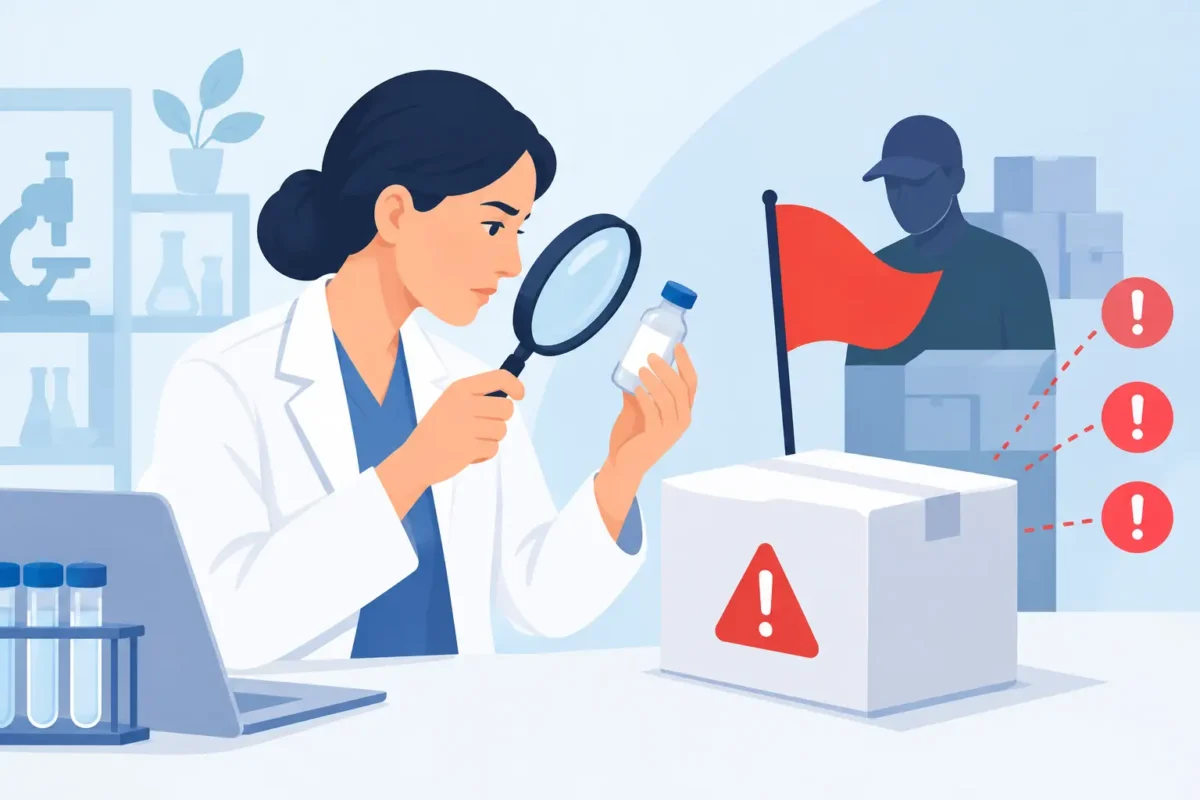
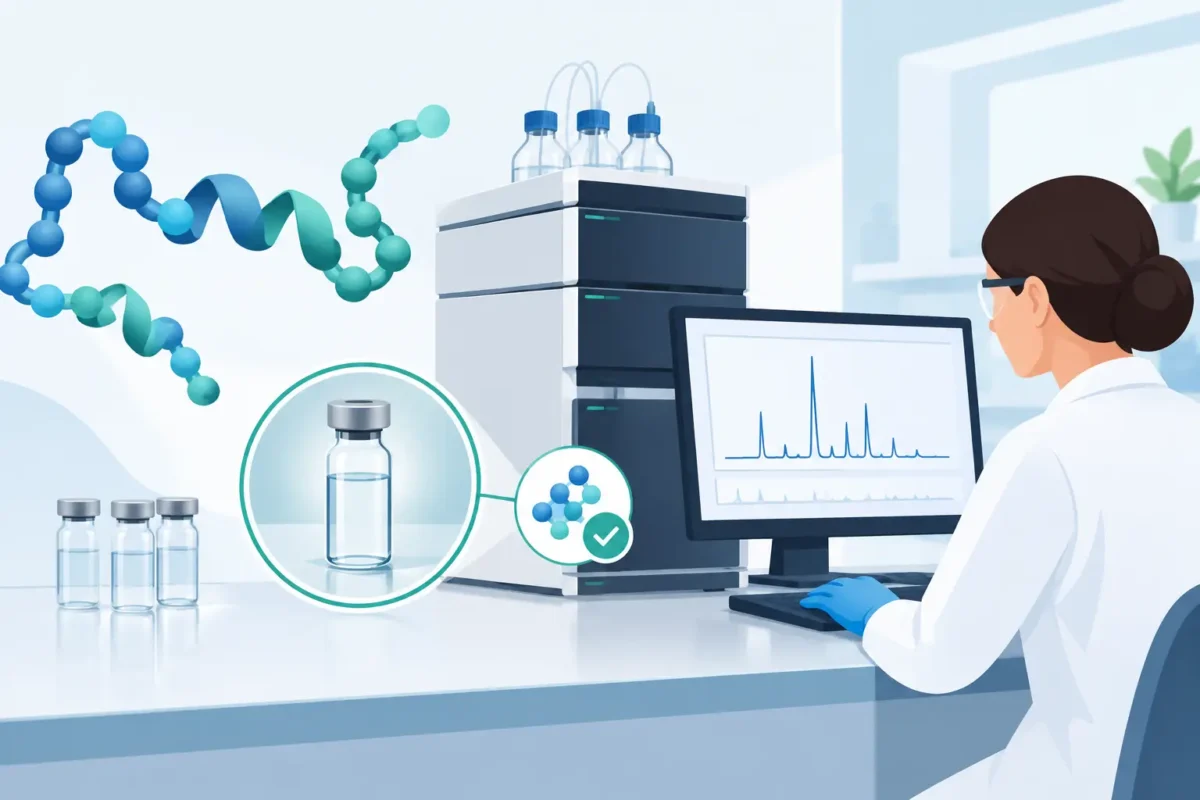
Because “TB-500” is not a protected or standardized term, two vials with the same label can contain different sequences. Researchers should look for third-party HPLC and mass spectrometry data that confirm the sequence, purity and batch.
Are They Interchangeable?
No. They share a biological origin and are often discussed together, but treating them as the same compound leads to unreliable comparisons. A study of full-length Tβ4 does not automatically validate a TB-500 fragment, and the reverse is also true.
Legal and Safety Status
Neither compound is approved by the U.S. FDA as a treatment, and both are sold for laboratory research only, not for human or veterinary use. Thymosin beta-4 and its modulators appear on the World Anti-Doping Agency prohibited list, so athletes should treat them as banned substances. Anyone with health questions should speak with a qualified medical professional, not rely on supplier marketing.
How to Choose Between Them for Research
- Define the question first. If the goal is to study the full biology of the protein, full-length Tβ4 is the more direct subject. If the goal is to study the actin-binding region specifically, a defined fragment may be appropriate.
- Confirm the exact sequence. Ask for the amino acid sequence, not just the product name.
- Require analytical proof. A certificate of analysis with HPLC purity and mass spectrometry results from an independent lab is the minimum standard.
- Check the literature for your exact compound. Do not cite Tβ4 papers as evidence for a fragment unless the study used that fragment.
- Document everything. Record lot numbers, storage conditions and handling so results can be reproduced.
Frequently Asked Questions
Is TB-500 the same as thymosin beta-4?
No. TB-500 is a synthetic peptide usually based on part of Tβ4. Thymosin beta-4 is the full 43-amino-acid natural protein.
Which one has more research behind it?
Thymosin beta-4. It has a much larger preclinical literature and some early clinical work with a recombinant form, while TB-500 has limited peer-reviewed data under that name.
Why do suppliers describe TB-500 differently?
There is no standard definition. Some use it for a short fragment and others for full-length Tβ4, so the sequence on the certificate of analysis is the only reliable guide.
Is either one approved for human use?
No. Neither is FDA-approved for general therapeutic use, and both are sold for research purposes only.
Are they allowed in competitive sport?
No. Thymosin beta-4 and related compounds are prohibited by WADA.
Final Takeaway
Thymosin beta-4 is the natural, well-characterized protein. TB-500 is a synthetic, loosely defined relative that is often a fragment of it. For researchers, the practical rule is simple: verify the sequence, demand independent lab data, and avoid assuming that results from one compound carry over to the other.
This article is for educational purposes only and is not medical advice. Products referenced are intended strictly for in vitro laboratory research.