A peptide vial labeled 99% pure may look straightforward, but that number only has value when the test method, sample lot, and supporting data are clear. Effective peptide purity testing methods distinguish between a clean chromatographic profile, correct molecular identity, measurable peptide content, and other quality attributes that can affect research handling.
For research-use-only materials, the right question is not simply, “What purity percentage is listed?” It is, “What did the laboratory measure, by which method, on which lot, and what does that result actually establish?” A lot-specific certificate of analysis, or COA, should help answer those questions without requiring the purchaser to fill in technical gaps.
What a Purity Result Can – and Cannot – Confirm
Purity is commonly reported as a percentage, often from an HPLC chromatogram. In practical terms, the percentage represents the relative area of the main detected peak compared with other peaks under a defined analytical method. A 99% HPLC purity result generally indicates that the target peak accounts for approximately 99% of the integrated chromatographic area at the selected detection wavelength.
That is useful information, but it is not a complete quality profile. HPLC area percentage does not independently establish that the main peak is the intended peptide, that the vial contains the labeled mass of peptide, or that the material is free of every non-UV-active contaminant. It also depends on the method conditions: column chemistry, mobile phases, gradient, detector wavelength, integration settings, and reference standard approach can all influence the result.
A reliable quality-control program therefore uses complementary tests. The appropriate panel depends on the peptide sequence, expected impurities, dosage form, intended research application, and risk profile. A short synthetic peptide in a lyophilized vial does not require the same analytical strategy as a longer sequence, a peptide blend, or a material intended for a highly controlled cell-based workflow.
Core Peptide Purity Testing Methods
RP-HPLC: The primary purity screen
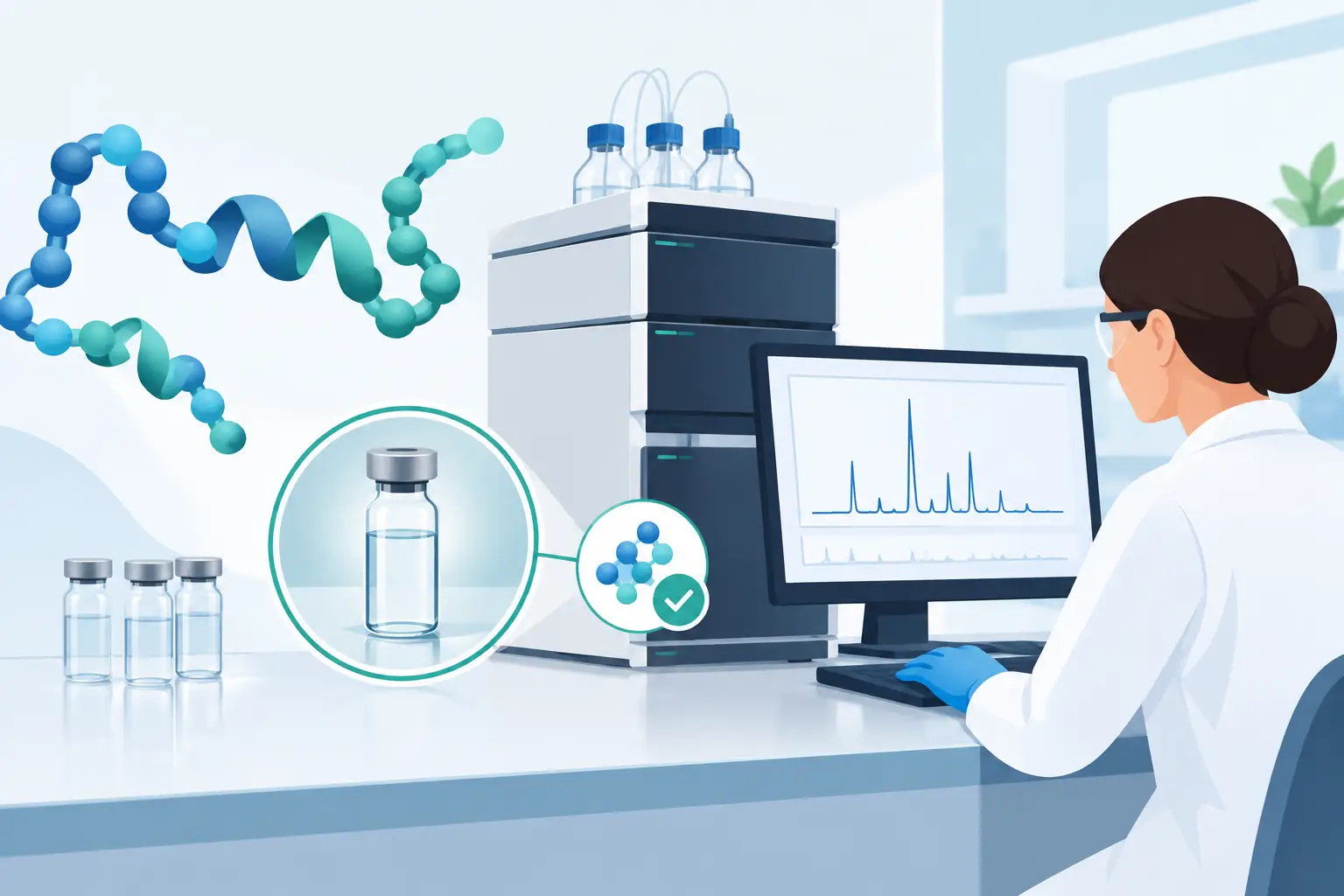
Reverse-phase high-performance liquid chromatography, usually shortened to RP-HPLC, is the workhorse method for synthetic peptide purity testing. The peptide sample passes through a hydrophobic column under a solvent gradient, and compounds separate according to their interactions with the stationary phase. UV detection, often around 214 nm or 220 nm for peptide bonds, records peaks as components elute.
RP-HPLC is highly effective for identifying related impurities such as deletion sequences, truncated products, oxidation products, deprotection byproducts, and some aggregation-related species. The resulting chromatogram can show whether the sample has one dominant peak or multiple meaningful peaks that warrant review.
Its limitation is equally clear: a peak at the expected retention time is not definitive proof of identity. Different compounds can co-elute, and impurities with weak UV absorbance may be underrepresented. HPLC purity should be read as a method-specific measure of chromatographic homogeneity, not as a stand-alone guarantee of identity or net peptide quantity.
LC-MS: Confirming molecular identity
Liquid chromatography-mass spectrometry combines chromatographic separation with mass detection. For a peptide supplier and research purchaser, LC-MS is one of the most valuable complementary tools because it can confirm whether the principal component has the expected molecular mass.
A well-documented LC-MS result should align the observed mass, or deconvoluted molecular weight, with the calculated mass for the intended sequence. This is particularly useful when reviewing peptides with similar chromatographic behavior, modified residues, disulfide bonds, or known oxidation pathways.
LC-MS can also reveal certain impurity masses, but its quantitative purity capability depends on validation and detector response. It should not automatically replace HPLC area-percent testing. Used together, HPLC answers how cleanly the sample separates under a defined method, while LC-MS provides evidence that the primary component is chemically consistent with the stated peptide.
Peptide mapping and sequence-focused analysis
For more complex peptides, peptide mapping can provide a deeper identity assessment. The material is enzymatically digested into predictable fragments, then analyzed by chromatography and mass spectrometry. The observed fragment pattern is compared with the expected sequence map.
This approach is especially informative when sequence confirmation matters beyond intact mass alone. Two different sequences can occasionally have similar intact molecular weights, while a fragment map can differentiate them. The trade-off is time, cost, and method complexity. It is not always necessary for every routine lot release, but it is a valuable higher-confidence method for complex or higher-risk materials.
Amino acid analysis: Measuring peptide content
Amino acid analysis, or AAA, measures amino acids after hydrolysis and can support determination of actual peptide content. This matters because a vial can show high HPLC purity while still containing variable amounts of water, salts, counterions, or residual processing components. In other words, chromatographic purity and peptide content are not interchangeable specifications.
AAA is useful when quantitative content must be established with greater confidence, particularly for reference materials, method development, or research protocols sensitive to concentration accuracy. It is more involved than a routine HPLC release test and may be reserved for qualification or periodic verification rather than every commercial lot.
Supporting Tests That Protect Research Quality
Purity is only one part of a meaningful COA. Depending on the material and handling conditions, supporting tests may include the following:
- Water content, often measured by Karl Fischer titration, which helps characterize lyophilized material and supports accurate mass-to-concentration calculations.
- Residual solvent testing, commonly performed by gas chromatography, to evaluate solvents remaining from synthesis or purification.
- Counterion or salt content, such as trifluoroacetate, acetate, or chloride, which can affect net peptide content and experimental calculations.
- Endotoxin and bioburden testing, which are not purity tests but may be relevant for research workflows where microbial contamination would compromise results.
- Appearance, reconstitution, and particulate inspection, which provide practical release checks for a lyophilized vial and its expected solution behavior.
Endotoxin results deserve careful interpretation. A low endotoxin value does not prove chemical purity, and a high HPLC purity percentage does not prove low endotoxin. They measure different quality attributes. Research purchasers should avoid treating one favorable test result as a substitute for the rest of the documentation.
How to Read a Lot-Specific COA
A COA should be tied to the exact lot purchased, not a generic example or a result carried over from an earlier production batch. Start by matching the product name, lot number, test date, and specification to the vial label or product documentation.
For HPLC, look for the stated purity result and the analytical conditions when available. A chromatogram is helpful because it shows the main peak and any visible secondary peaks. A result without a method or trace is less informative than a certificate that identifies the technique, detector wavelength, and acceptance criterion.
For identity, look for an LC-MS result showing calculated and observed molecular mass. The values should be consistent within the laboratory’s stated tolerance. If a product contains a blend, documentation should identify each component and explain whether testing is performed on individual ingredients, the final blend, or both.
Also review what the COA does not claim. A purity assay should not be presented as sterility testing. A molecular-mass result should not be presented as quantitative content testing. Clear scope is a quality signal because it reflects disciplined reporting rather than broad, unsupported language.
Matching the Test Panel to the Research Use
Not every research purchase requires the same level of analytical depth. For routine exploratory work, a lot-specific HPLC purity result supported by LC-MS identity confirmation may be an appropriate baseline. When concentration accuracy, assay sensitivity, or reproducibility across repeated studies is critical, water content, peptide-content data, counterion information, and expanded impurity characterization become more relevant.
Storage and handling should remain part of the quality discussion. Even a properly tested peptide can change after repeated temperature cycling, prolonged exposure to moisture, or inconsistent reconstitution practices. Maintain documented storage conditions, use appropriate diluents for the research protocol, label reconstituted solutions clearly, and avoid assuming that a release COA covers changes introduced after delivery.
The strongest purchasing standard is practical: select materials supported by a lot-specific record, use the reported test method to understand the claim being made, and retain the documentation alongside your research records. That habit gives every vial a traceable place in the work that follows.